What Lessons are there for Today’s Health Crises?
By Dr. Howard Ehrman
On January 1, 2026 millions of U.S. residents whose health coverage is subsidized by the Affordable Care Act (ACA) will lose their health insurance, Medicaid and/or go deeper into debt and poverty.
Many will turn to what is left of rural and urban public hospitals, public clinics, public health departments and federally qualified health centers (FQHC’s) all of whose budgets have been slashed.
What is needed today is what was created before, during and after the 1975 Cook County Hospital Resident Doctors’ strike, the longest in U.S. history: a broad, grassroots people’s health movement of workers, patients, labor unions, community based and religious organizations to demand taxing the rich and corporations in cities, counties, states and at the federal level to adequately fund and staff all that encompasses health.
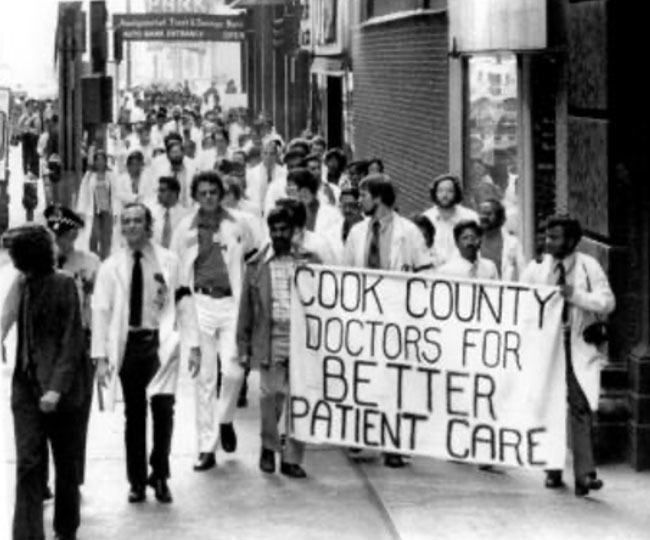
Beginning October 27 until November 14, 1975, the Cook County Hospital (CCH) House Staff Association (HSA) of resident doctors in training was forced to go on strike for 18 days for the staff, supplies and equipment necessary to provide quality medical care to the patients.
It was the longest doctors’ strike in U.S. history to date.
The pivotal issue in the strike was the right and responsibility of doctors to work to improve delivery of public health care. As Dr. Kevin Geraghty. a spokesperson for the striking doctors, stated: “Very clearly the only things that make us willing to go to jail, to face fines and to lose credit for our training are patient care issues. Salary is not a big issue. The issue here is do the people have a right to receive quality health care or, because of circumstances of birth should they be subjected to dangers that the more affluent people don’t face.”
The quality of care demands which were won included raising the number of paramedical personnel on the wards and in the emergency room 24 hours a day; insuring round-the-clock availability of X-ray services and a variety of diagnostic laboratory tests, such as urinalysis, hematology, and cardiac enzyme panels; establishment of a committee to provide training in cardiopulmonary resuscitation for appropriate personnel, and providing adequate and competent Spanish-speaking translators on duty 7 days a week, 24 hours a day.
What Factors Laid the Basis for the Strike?
In 1973 more than 600 resident house staff doctors in training organized into a labor union at Cook County Hospital in Chicago, one the three largest in the U.S. during the 20th century.
The doctors were both international medical graduates (IMG’s) from the global south and U.S. trained physicians who had grown up watching or participating in anti-colonial national liberation movements and civil rights struggles for health equity, education and social justice.
The first contract, drafted in 1974, contained primarily patient care, equipment, supplies, staffing and Spanish translator issues plus the demand to reduce weekly house staff hours from 100 to 80 per week.
The draft contract contained many items that came directly from patients and their families and from other Cook County Hospital workers-housekeepers, transporters, nurses, lab workers and more.
Members of the house staff, including a few with union and labor organizing experience began to meet with hospital workers from all sectors, particularly housekeepers, transporters and nurses to prioritize the contract demands for patient care which intersected directly with working conditions.
These meetings turned into an all worker coalition across unions, even though they were not officially sanctioned by union leadership outside of the HAS.
The all worker coalition developed strategy and tactics, especially those who were from Chicago’s African American and Latino communities to implement an outreach plan to those neighborhoods, churches and organizations where the largest percentage of patients lived.
Thus the all worker coalition spawned a work-community coalition, that latter included some labor unions from outside the hospital-The Chicago Labor Federation, United Steelworkers and others that supported the contract demands that they helped develop and sustained the strike for 18 days through rallies, marches, speeches, publicity and more.
The inadequacies of Chicago’s Cook County Hospital have been amply documented. U.S. Senate Committee hearings of June, 1974 described the hospital as the “bulwark of Chicago’s apartheid health system. On the basis of present facilities quality patient care is impossible.”
Until 1967, when the long time Cook County Hospital Director and Surgeon, Dr. Karl Meyer, retired Cook County literally had an apartheid hospital. Wealthy white, private patients had their own elevator that took them to some of the most luxurious hospital facilities in the United Sates on Cook County’s 7th floor where chefs prepared gourmet cuisine from a year around vegetable garden greenhouse. Their rooms were the only ones air conditioned and each of the surgical suites were state of the art.
The up to 3,000 public, mostly African American, Latino and poor white patients were on wards of 60 people in one room with no privacy, no curtains between their beds, no air conditioning and inadequate bathrooms, showers and toilets, but plenty of rats.
In response to the problems at Cook County Hospital, various proposals were offered to close the hospital down, and transfer the hospital’s patient load to other institutions within the city. However, the importance of upgrading services and reversing the deteriorating trend within the hospital has been emphasized by many people in Chicago involved in ‘public health care delivery.
A health worker in Chicago explained the particular importance of Cook County Hospital: “Located in the midst of Chicago’s west side black ghetto, the hospital serves as the primary care center for many of Chicago’s one and a half million black residents, and is utilized by many latinos and poor whites as well. Most people agree that the care provided at Cook County Hospital is second rate. It is not by choice or chance that poor people throughout the city travel long distances, bypassing local private institutions, to spend long hours in endless lines in the emergency room, clinics, and pharmacy to be seen by an overworked house staff.
They come because Cook County is still the only hospital in the city that provides free health care. For people whose’ Medicare and Medicaid coverage would not begin to cover the costs of private hospital or doctor care, and for those who are unemployed or not covered by any health insurance plan, Cook County is the only place to turn. These people are treated scornfully at private hospitals, where they are seen as ‘charity cases,’ 1 and are frequently simply denied treatment and shipped over to County, often without even emergency care.
Patient care activities account for well over 70% of house staff time, as verified by numerous studies.
On November 25, 1974, the Howard University House Officers Association (HOA) struck Freedman’s Hospital for 12 days over multiple grievances. The HOA won a commitment from the hospital to upgrade laboratory services, to provide better nursing coverage, and to improve house-staff fringe benefits such as malpractice insurance coverage
Earlier in 1975, there were strikes by interns and residents in New York and Los Angeles. The New York strike lasted four days, ending March 20, and was over wages, hours and working conditions.
An underlying issue was the role of the young doctors in management, particularly in the CCH strike. This issue still has national implications for teaching hospitals around the country.
After the Cook County 18-day strike, the HSA won the right to have a say in patient care decisions and quality standards. The contract contained extensive, itemized patient care improvements. It also created a Medical Care Review Committee to carry out the improvements and deal with future patient care problems.
The Cook County settlement was a landmark, calling for a committee of five house staff and five attending staff to oversee implementation of patient care improvements including adequate numbers of Spanish language interpreters, more intravenous teams, faster processing of lab and X-ray requests, and a maximum workweek of 80 hours (one night in four).
House-staff associations were also successful in publicizing the plight of underfunded, understaffed, large, urban, public hospitals.
The neoliberal agenda, whose U.S. and global implementation began in earnest with the illegal, CIA & “Chicago Boys” engineered overthrow and assassination of Chilean President, Former Health Minister and Physician, Dr. Salvador Allende on September, 1973, resulted in many U.S. rural and urban public hospital closures, cutbacks in beds and staff, conversion to chronic care facilities, and take-over by the private sector.
The 1975 Cook County Hospital resident doctors strike inspired more rank and file worker organizing inside the hospital, including the 1976 Cook County nurses strike, one of the largest and longest in U.S. history.
Two years later, in 1978, a severe financial crisis faced Cook County Hospital that was caused by state and federal funding cuts backed by neoliberal republicans and democrats who wanted to privatize Cook County’s patients to private hospitals who suddenly wanted the County’s poor if they had Medicare and/or Medicaid to fill their empty beds.
The privatization effort also included its innovative, world famous burns and trauma units.
These cuts resulted in staff reductions, the halting of physical plant improvements, and the closing of essential services. As a result, Cook County Hospital could not pay their employees for a short period.
Consequently, the HSA joined other unions, rank and file hospital workers, and civil rights and community groups, to create the Committee to Save Cook County Hospital, a large, grass-root, mass movement that held marches, demonstrations, rallies, press conferences, circulated petitions, and successfully lobbied the state, all of which resulted in creating a better financial base for Cook County Hospital and Health services to continue to operate.
Saving Cook County Hospital for the communities it serves rewarded the efforts of the HSA and the other groups.
As the strike ended, members of the HSA faced the threat of jail and substantial fines. The Governing Commission sought and obtained a temporary restraining order declaring the strike illegal and ordering the doctors back to work at the strike’s inception. Because the doctors felt that they were maintaining appropriate commitments to the hospital’s patients, they continued their strike. In the strike’s aftermath, seven House staff Association members faced 10–day jail sentences in Cook County Jail, and the organization was fined $10,000 on contempt of court charges arising from defiance of the temporary restraining order. Eventually these charges were dropped.
The lessons of the 1975 strike and its aftermath are crucial to adapt to today’s health crises. More health workers of all types are unionized, but not all unions are fighting to protect the health, safety, living standards and adequate staffing conditions of health workers.
COVID dramatically exposed this with almost complete lack of personal protective equipment (PPE) for heat workers, resulting in the deaths of more than 3,600 U.S. healthcare workers in the first year of COVID.
Nursing, housekeeping, lab techs as well as doctor staffing levels that were inadequate before COVID have gotten much worse since.
The lessons of the 1975 Cook County Hospital HSA strike is as important today as it was then especially for all remaining public hospitals, public clinics and public health departments all of which have had their federal budgets slashed: (1) step by step build an all hospital coalition of all types of workers both unionized and non-union even if not supported by each union’s leadership (2) listen to the patients and what they believe would improve their in patient and outpatient conditions and include them in the coalition (3) go to the communities, organizations, unions who are most likely to use the public health facilities and departments and develop demands to increase local, county and state funding by increasing funding from the wealthy and corporations.
Sources:
Studs Terkel Interview:
- https://studsterkel.wfmt.com/programs/studs-terkel-interviews-three-cook-county-hospital-doctors-about-their-1975-strike
- https://www.nytimes.com/1975/10/28/archives/a-chicago-hospital-struck-by-doctors.html
- https://www.nytimes.com/1975/10/30/archives/doctors-striking-hospital-in-chicago-call-quality-of-patient-care-a.html
- https://www.nytimes.com/1975/11/14/archives/chicago-doctors-end-18day-strike-leader-claims-victory-after.html
- https://www.chicagotribune.com/2016/04/05/then-and-now-cook-county-hospital/
Howard Ehrman, MD, MPH is the former Chicago Assistant Health Commissioner and retired University of Illinois Chicago (UIC) Assistant Professor of Family Medicine & Public Health.
As a first year Family Medicine Resident Elected Representative to the Cook County HSA Union, Dr. Ehrman was one of four co-authors of the 1974 Contract that was the basis for the 1975 strike. He was also a member of the negotiating and strike committee.